
Article
Japanese contentHow to turn strong X posts into first-reply drafts and queue them in TenguX
Teams that want to use reply-based X engagement more intentionally instead of replying ad hoc / Published: 03/18/2026 · Updated: 03/21/2026
This article is currently available in Japanese.
The article UI is localized, and English article content is being added progressively.
Finding a good source post is not the same as building a repeatable reply workflow.
Most teams treat replies as spontaneous work. They see a promising post, decide in the moment whether to reply, and then lose the thread as soon as the day gets busy. That creates a reply habit with no queue, no weekly rhythm, and no operating standard.
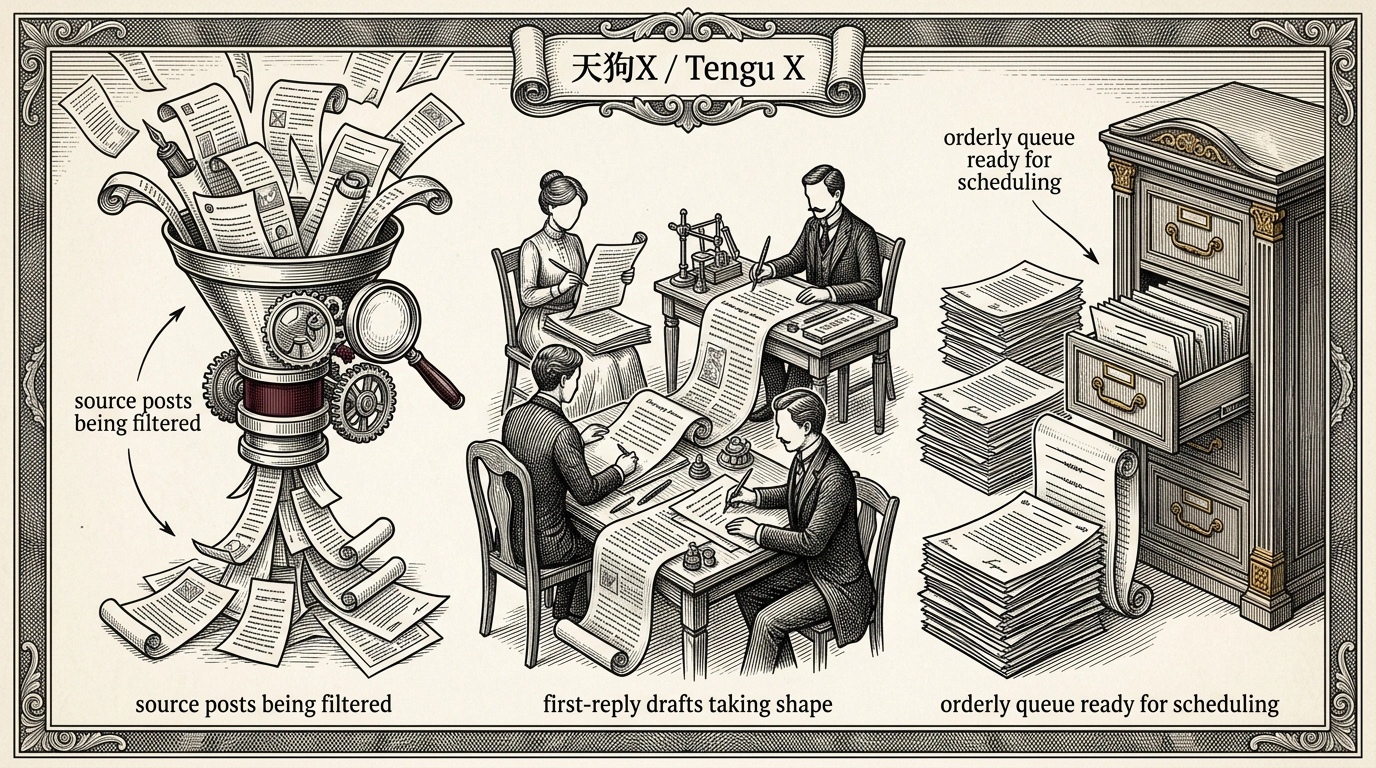
The value of TenguX is that it can shorten the path from search to usable reply draft. This guide explains how to connect search, first-reply drafting, and queue placement into one practical flow.
Bottom line: do not manage replies as random reactions
The useful metric is not how many interesting posts you saw. It is how many reply opportunities actually moved forward.
Track these three numbers:
- how many source posts stayed as reply candidates
- how many candidates became usable first replies
- how many replies were added to the queue
If discovery is improving but queue movement is not, your workflow is still fragmented.
Who this workflow fits
This is especially useful if your team:
- finds promising posts but rarely replies with intention
- wants a better first-reply standard than "say something nice"
- wants conversation-driven X activity to become part of weekly execution
The workflow at a glance
| Stage | Purpose | Done when |
|---|---|---|
| Search | Find posts that are worth replying to | 3 to 5 reply candidates remain |
| Reply | Create a first reply with a clear angle | 1 to 2 replies are usable |
| Queue | Move the strongest reply opportunities into this week's plan | at least 1 reply is queued |
Step 1. Use Search to keep only reply-worthy posts
A strong reply source post usually has three traits:
- the author's point is clear
- you can add one useful angle without forcing it
- a real follow-up conversation is possible
That matters because "interesting" is not the right standard here. "Easy to extend with value" is the better one.
If your sourcing is noisy, start with the existing search method guide.
Step 2. Decide what value the reply adds before drafting
Do not start by writing full sentences. Start by choosing one of these roles:
- add operating context
- add one concrete example
- ask one narrow question
If you skip this step, the reply draft usually turns into one of two bad shapes:
- a summary of the original post
- a soft sales pitch with no real conversation hook
If that sounds familiar, pair this workflow with the published first reply fix guide.
Step 3. Polish only the good drafts
Not every candidate deserves editing time.
When reviewing a first-reply draft, check only three things:
- does it add something instead of repeating the post
- does it feel answerable
- does it avoid sounding promotional too early
That is enough to decide whether the reply is queue-worthy.
Step 4. Queue replies with a simple rule set
Replies often fail operationally because there is no standard for what enters the queue.
Use three filters:
- it matches this week's conversation theme
- it adds one clear layer of value
- it is likely to lead to either a public conversation or a profile visit
That keeps reply work connected to the wider X operating system instead of leaving it as isolated engagement.
If your team already struggles to move saved ideas into actual publishing slots, the existing saved ideas to queue workflow is a useful companion article.
Use a minimal weekly scorecard
Do not add too many metrics at first. Three are enough:
- how many posts survived as reply candidates
- how many candidates became usable first replies
- how many replies actually reached the queue
Those three numbers make it easier to see whether the workflow is failing at sourcing, reply quality, or queue discipline. For the quality bar itself, use the published first reply fix guide.
A lightweight weekly operating model
You do not need a large system to start. One short weekly block is enough:
First 10 minutes: shortlist reply candidates
Keep only 3 posts that are worth extending.
Next 5 minutes: create one-angle reply drafts
For each source post, choose one role: context, example, or question.
Final 5 minutes: queue the best one
Do not judge perfection. Judge whether the reply belongs in this week's active plan.
What usually blocks this workflow
Too many candidates stay alive
Once the list gets too large, the team spends more time comparing posts than replying.
The reply has no clear job
If the draft is trying to agree, teach, ask, and sell at the same time, it will weaken fast.
There is no queue rule
Without a clear handoff into the queue, replies stay as ideas instead of turning into action.
Summary
The search-to-reply-to-queue flow is useful because it turns reactive reply work into a repeatable operating line.
- Search should keep only reply-worthy posts
- Reply drafting should choose one value-add first
- Queue placement should use a small, explicit rule set
If you want replies to become part of your X system instead of something you do only when inspired, start by queuing just one strong reply opportunity each week.
Resources
Related resources
Use these templates and references to apply the article workflow directly in your own operations.
Next action
If you want to try this flow yourself, start by creating draft ideas for one theme.